
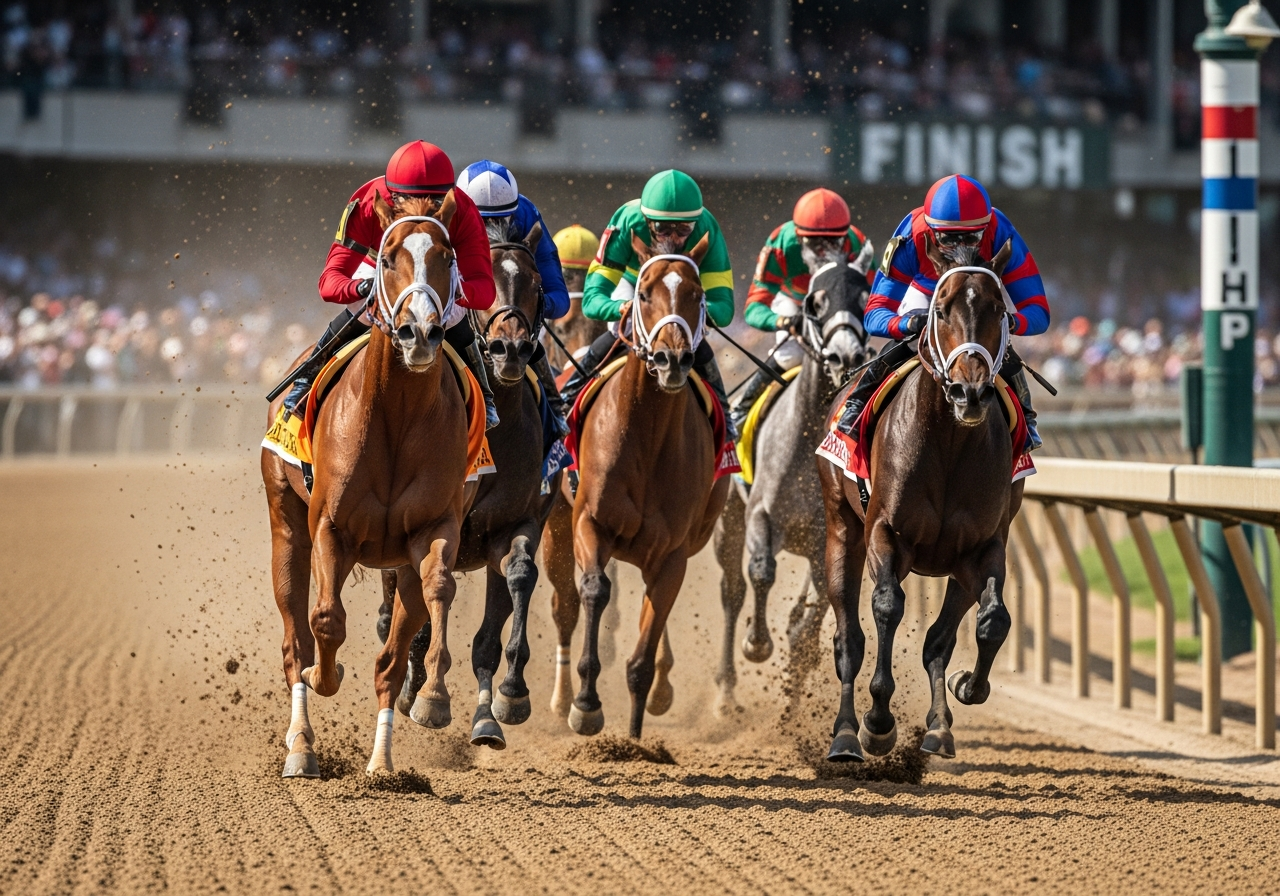
The thundering hooves of 20 thoroughbreds charge toward the finish line at Churchill Downs as thousands of bettors hold their breath, watching their Kentucky Derby wagers unfold. But behind the excitement lies a fundamental choice that shapes how much money those bettors will win or lose: the difference between fixed-odds and pari-mutuel betting systems. While most US sportsbooks operate on fixed-odds models where your payout is locked in when you place your bet, horse racing tracks across America have traditionally relied on pari-mutuel wagering, where all bets are pooled together and payouts fluctuate until post time.
Understanding these two distinct payout systems is crucial for any serious bettor navigating the diverse landscape of US gambling markets. Pari-mutuel betting dominates American horse racing, from the Kentucky Derby to local tracks in every state, while fixed-odds systems reign supreme in traditional sportsbooks covering everything from NFL games to March Madness. Each system offers unique advantages and challenges that can significantly impact your betting strategy and potential returns.
What is Fixed-Odds Betting?
Fixed-odds betting represents the traditional bookmaker model where the odds and potential payout are determined and locked in at the moment you place your wager. When you bet $100 on a horse at 5-1 odds, you know immediately that a winning bet will return $500 in profit plus your original stake, regardless of how many other people bet on the same horse afterward. This system contrasts sharply with traditional pari-mutuel wagering, where your final payout depends on the total betting pool and remains unknown until all betting closes.
In the United States, fixed-odds betting dominates the sportsbook industry, from major operators like DraftKings and FanDuel to regional casinos offering sports wagering. Recently, several states have also begun experimenting with fixed-odds horse racing betting, offering an alternative to the pari-mutuel systems that have long monopolized American tracks. New Jersey launched fixed-odds horse racing in 2022, followed by other states exploring similar models to attract younger bettors more familiar with traditional sportsbook formats.
The appeal of fixed-odds betting lies in its transparency and predictability. Bettors can calculate their exact potential returns before committing money, allowing for more precise bankroll management and strategic planning. This certainty has made fixed-odds the preferred system for most forms of sports betting beyond horse racing, where quick decisions and clear value propositions drive the betting experience.
How Payouts Are Calculated
Fixed-odds payouts follow a straightforward mathematical formula: (Bet Amount × Odds) + Original Stake = Total Return. If you place a $50 bet on a horse at 8-1 odds, your calculation becomes ($50 × 8) + $50 = $450 total return, representing $400 in profit. This formula remains constant regardless of how the betting action shifts after you place your wager.
The simplicity extends to fractional, decimal, and American odds formats commonly used across US betting markets. A horse listed at +800 in American odds, 8/1 in fractional odds, or 9.00 in decimal odds all represent the same fixed payout structure, ensuring bettors can quickly assess potential returns and make informed decisions without complex calculations or uncertainty about final payouts.
Advantages in US Markets
- Guaranteed payout certainty: Your winnings are locked in immediately when you place the bet, eliminating any surprises at payout time regardless of late betting action.
- Early value capture: Sharp bettors can lock in favorable odds before line movements, especially important in volatile markets like horse racing where information can quickly shift public perception.
- Simple bankroll management: Knowing exact potential returns allows for precise staking strategies and risk assessment without waiting for pool closures to determine actual payouts.
- Familiar format for American bettors: Most US sports bettors are accustomed to fixed-odds from football, basketball, and other mainstream sports wagering.
- Strategic betting windows: Bettors can take advantage of early odds before sharp money moves lines, particularly valuable in racing markets where morning line odds often differ significantly from final odds.
What is Pari-Mutuel Betting?
Pari-mutuel betting operates on a fundamentally different principle where all wagers are pooled together, the track takes its percentage (typically 15-25% depending on bet type), and the remaining money is distributed among winning bettors based on how much they wagered. The French term “pari-mutuel” literally means “betting among ourselves,” reflecting how bettors are essentially wagering against each other rather than against a bookmaker. This system ensures the track profits regardless of race outcomes, as their percentage is removed before any payouts are calculated.
Unlike fixed-odds betting, pari-mutuel odds fluctuate continuously until the moment betting closes, with final payouts determined only after all money is counted and the track’s takeout is deducted. This creates a dynamic environment where early bettors might see their odds improve or worsen dramatically based on late betting action. US horse racing has operated almost exclusively on this system since the early 20th century, making it the standard format at iconic venues from Churchill Downs to Santa Anita Park.
The pari-mutuel system leads US horse racing because it provides tracks with guaranteed revenue while creating larger potential payouts for bettors willing to accept uncertainty. When a longshot wins with minimal support in the betting pools, the few backers can receive massive payouts that would be impossible under a fixed-odds system where bookmakers need to manage their risk exposure carefully.
Pool Mechanics and Takeout
Understanding pari-mutuel pool mechanics requires examining how money flows through the system from bet placement to final payout. Consider a simplified win pool of $10,000 where the track takes an 18% takeout, leaving $8,200 for distribution among winning bettors. If $2,000 was bet on the winning horse, each dollar wagered returns approximately $4.10 ($8,200 ÷ $2,000), creating odds of roughly 3-1 for those backers.
The takeout percentage varies significantly across different bet types and jurisdictions, with straight win bets typically carrying the lowest takeout (15-18%) while exotic wagers like superfectas can reach 25% or higher. This creates a mathematical reality where pari-mutuel betting generally offers lower theoretical returns than fixed-odds betting, but the potential for massive payouts on longshots and exotic combinations can more than compensate skilled bettors. Track takeout also funds purses, operations, and in many states, contributes to general tax revenue, making pari-mutuel betting an important economic driver beyond its gambling function.
Pool sizes directly impact payout accuracy and value, with larger pools generally producing more efficient odds that better reflect true probabilities. Small pools can create significant overlay and underlay situations where skilled bettors can find mathematical advantages, particularly in exotic wagers where casual bettors often make poor combinations that create value for more knowledgeable players.
Key Differences in Payout Structures
| Aspect | Fixed-Odds | Pari-Mutuel | US Example |
|---|---|---|---|
| Odds Determination | Set by bookmaker, locked at bet placement | Determined by betting pool, fluctuates until close | DraftKings vs Churchill Downs |
| Payout Certainty | 100% certain when bet is placed | Unknown until all betting closes | NFL bet vs Derby exacta |
| Risk Bearer | Bookmaker assumes liability risk | Bettors wager against each other | Sportsbook vs racetrack model |
| Late Betting Impact | No effect on existing bets | Can dramatically alter all payouts | College football vs Preakness |
| Maximum Payouts | Limited by bookmaker’s risk tolerance | Potentially unlimited based on pool size | $500K limit vs $1M+ Pick 6 payouts |
The fundamental distinction between these systems lies in when and how odds are determined, creating entirely different strategic considerations for bettors. Fixed-odds betting provides immediate certainty but limits potential upside, while pari-mutuel wagering offers unlimited payout potential at the cost of uncertainty until betting closes.
Odds Fluctuation Impact
Late betting action creates vastly different experiences under each system, with pari-mutuel bettors facing the constant possibility that their potential payouts will change dramatically in the final minutes before post time. A horse showing 8-1 odds twenty minutes before a race might close at 3-1 if major money arrives late, cutting potential winnings in half for early backers. Conversely, if late money flows away from your selection toward other horses, your potential payout could increase significantly.
Fixed-odds bettors enjoy immunity from these fluctuations, creating strategic advantages for those who identify value early but want protection from market movements. This stability proves particularly valuable in volatile racing markets where trainer comments, weather changes, or late scratches can trigger dramatic shifts in betting patterns that would affect pari-mutuel payouts but leave fixed-odds wagers unchanged.
Takeout and House Edge
The mathematical advantage differs significantly between systems, with pari-mutuel tracks typically extracting 15-25% takeout compared to sportsbooks that generally build 4-10% margins into their odds. However, this comparison oversimplifies the reality since pari-mutuel pools can create overlay situations where skilled bettors find positive expected value, while fixed-odds betting rarely offers true mathematical advantages to players.
Pari-mutuel takeout serves multiple purposes beyond operator profit, funding horse racing purses, track operations, and state tax obligations, while sportsbook margins primarily represent pure profit for operators. This difference explains why US racing has maintained pari-mutuel systems despite their higher takeout rates, as the ecosystem requires substantial revenue generation to support breeding, training, and racing infrastructure that creates the product being wagered upon.
Pros and Cons Comparison
| Type | Pros | Cons |
|---|---|---|
| Fixed-Odds | Guaranteed payouts, early value capture, precise bankroll management, familiar format | Limited maximum payouts, bookmaker risk management, potential account restrictions |
| Pari-Mutuel | Unlimited payout potential, overlay opportunities, no account limits, supports racing ecosystem | High takeout rates, payout uncertainty, vulnerable to late money, complex odds calculations |
| US Tracks (Pari-Mutuel) | Traditional Derby experience, massive exotic payouts, rebate programs for volume players | Aging customer base, intimidating for newcomers, declining handle at many venues |
| Sportsbooks (Fixed-Odds) | User-friendly interfaces, promotional offers, mobile convenience, instant settlement | Limited horse racing options, potential winner restrictions, profit-driven line setting |
| Hybrid Models | Best of both worlds, choice flexibility, market competition benefits | Limited availability, regulatory complexity, potential market confusion |
| Traditional Tracks | Authentic racing atmosphere, knowledgeable communities, historical significance | Outdated technology, inconvenient locations, limited operating schedules |
Strategic Implications
- Early betting advantages: Fixed-odds systems reward bettors who identify value before line movements, while pari-mutuel pools can improve for contrarian bettors backing unpopular selections that attract little late money.
- Bankroll volatility management: Fixed-odds betting allows for consistent staking strategies based on known payouts, whereas pari-mutuel wagering requires flexible approaches that account for payout uncertainty and potential windfall scenarios.
- Information timing value: Late-breaking news affects these systems differently, with fixed-odds bettors protected from post-bet developments while pari-mutuel players can potentially benefit from or be harmed by information that shifts late betting patterns.
- Volume player considerations: High-volume bettors often prefer pari-mutuel systems for their rebate programs and lack of winner restrictions, while casual players typically favor fixed-odds simplicity and promotional offerings from sportsbooks.
Pari-Mutuel in US Horse Racing
Pari-mutuel betting serves as the backbone of American horse racing, from the Kentucky Derby’s massive pools that can exceed $100 million across all wagers to small-track operations where daily handle might total just thousands of dollars. This system became the standard for US racing in the early 1900s when states needed a way to regulate and tax horse racing while ensuring fair competition. The pari-mutuel model solved multiple problems simultaneously: it eliminated concerns about bookmaker corruption, provided clear tax collection mechanisms, and created a sustainable funding source for racing purses and operations.
Every major American racing venue operates primarily on pari-mutuel wagering, making it the default system for iconic events like the Triple Crown races, Breeders’ Cup championships, and daily racing at tracks from Saratoga to Del Mar. The system’s deep integration into racing culture means that traditional horseplayers often view pari-mutuel betting not just as a wagering method but as an essential element of the sport’s authenticity and competitive integrity.
The pari-mutuel standard extends beyond individual tracks through advance deposit wagering (ADW) platforms and off-track betting facilities that aggregate pools from multiple venues. This network effect creates larger, more liquid betting pools that improve odds accuracy while providing bettors access to racing from across the country, though it also means that major betting centers can dominate smaller tracks’ pool dynamics.
Examples from Tracks
| Bet Type | Typical Takeout | Pool Example |
|---|---|---|
| Win/Place/Show | 15-18% | $50,000 Derby win pool, $8,200 net payout |
| Exacta | 19-22% | $25,000 pool, 12-7 combo pays $847.60 |
| Trifecta | 22-25% | $15,000 pool, longshot combo pays $3,240 |
| Pick 4 | 23-26% | $8,000 pool, single winner takes $5,920 |
Odds Display and Reading
Understanding pari-mutuel odds displays requires recognizing that the numbers represent approximate payouts based on current pool distributions, not fixed returns. When you see a horse listed at 5-1 on the tote board, this indicates the horse would pay approximately $12.00 for every $2 wagered if betting stopped immediately, but this figure will change with every additional bet until post time. The minimum payout in most US racing is $2.10 on a $2 bet, even for overwhelming favorites, ensuring some return for successful wagers regardless of how heavily favored a horse becomes.
Fractional odds translation in pari-mutuel systems can confuse bettors accustomed to fixed-odds formats, since a horse showing 3-1 might actually pay $8.40, $7.60, or $9.20 depending on the exact pool mathematics and breakage rules that round payouts to standardized increments. Experienced pari-mutuel players learn to focus on will-pay displays that show exact potential returns rather than traditional odds ratios, providing more accurate information for betting decisions in the fluid pool environment.
Fixed-Odds in US Sportsbooks
The expansion of legal sports betting across the United States has created new opportunities for fixed-odds horse racing, with several states authorizing this alternative to traditional pari-mutuel systems. New Jersey pioneered legal fixed-odds racing in the US market, followed by states like West Virginia and others exploring similar frameworks that appeal to younger demographics more familiar with standard sportsbook operations. These developments represent a significant shift in American racing’s betting landscape, offering bettors choice between traditional pari-mutuel pools and the certainty of fixed-odds wagering.
State-specific patterns in fixed-odds adoption reflect varying regulatory approaches and market conditions, with some jurisdictions requiring fixed-odds operators to contribute to racing purse funds while others treat these wagers similarly to other sports bets. Major sportsbooks like FanDuel and DraftKings have begun offering fixed-odds racing in authorized states, typically focusing on major races and marquee events where they can manage risk exposure while attracting customers who might otherwise avoid traditional track betting.
Availability and Limits
- Geographic restrictions: Fixed-odds horse racing remains limited to specific states with enabling legislation, creating a patchwork of availability that varies significantly across regions.
- Event selection limitations: Most sportsbooks offering fixed-odds racing focus on major tracks and featured races, providing less comprehensive coverage than traditional ADW platforms.
- Betting limits and maximums: Fixed-odds racing typically carries lower maximum bet limits than other sports, often capping individual wagers at $1,000-$5,000 compared to higher limits for football or basketball.
- Account restrictions for winners: Successful fixed-odds bettors may face account limitations or closure, similar to other sports betting, while pari-mutuel systems rarely restrict winning players.
- International comparison models: European and Australian markets demonstrate successful large-scale fixed-odds racing operations, suggesting potential for expansion in US markets with appropriate regulatory frameworks.
Which is Better for Bettors?
| Bettor Type | Recommended System | Reason | US Scenario |
|---|---|---|---|
| Sharp/Professional | Pari-Mutuel | Overlay opportunities, no winner restrictions, rebate programs | High-volume ADW play with 8-12% rebates |
| Casual/Recreational | Fixed-Odds | Simple interface, known payouts, promotional bonuses | Kentucky Derby betting via DraftKings |
| Early Planners | Fixed-Odds | Value lock-in, protection from late money movements | Future book betting months before major races |
| Longshot Hunters | Pari-Mutuel | Unlimited payout potential, exotic wager availability | Pick 6 tickets targeting million-dollar payouts |
| Technology-Focused | Fixed-Odds | Modern mobile apps, instant settlement, familiar format | Younger demographics preferring sportsbook experience |
The optimal choice between fixed-odds and pari-mutuel betting depends heavily on individual betting style, risk tolerance, and strategic objectives. Professional bettors often prefer pari-mutuel systems despite higher takeout rates because of overlay opportunities and volume rebate programs that can create positive expected value, while recreational players typically find fixed-odds more accessible and user-friendly for occasional wagering.
Strategies for Each
- Fixed-odds early value strategy: Focus on identifying undervalued horses in morning lines or early betting, then lock in favorable odds before sharp money moves the market against you.
- Pari-mutuel contrarian approach: Target unpopular horses with solid chances that might attract minimal late money, potentially improving your payout as pools close with heavy action on other selections.
- Hybrid bankroll allocation: Use fixed-odds for high-confidence plays where you want guaranteed returns, while reserving pari-mutuel betting for speculative wagers targeting large payouts.
- Information timing exploitation: In fixed-odds markets, bet early on positive information, while in pari-mutuel pools consider waiting for late developments that might shift odds favorably.
- Volume optimization tactics: High-volume players should pursue pari-mutuel rebate programs that can add 8-12% to theoretical returns, while casual bettors might benefit more from fixed-odds promotional offers and signup bonuses.
- Risk management differentiation: Use fixed-odds for conservative bankroll management with known outcomes, but embrace pari-mutuel volatility when seeking life-changing scores through exotic wagers.
- Track-specific specialization: Develop expertise in particular tracks’ pari-mutuel patterns and pool dynamics, while maintaining fixed-odds accounts for major racing events with line shopping opportunities.
Kentucky Derby Case Study
The Kentucky Derby provides an excellent case study for comparing betting systems, as it’s available in both pari-mutuel and fixed-odds formats in many markets. In the 2023 Derby, early fixed-odds markets offered Mage at approximately 12-1 odds several hours before post time, allowing bettors to lock in those generous returns regardless of late betting action. Meanwhile, the pari-mutuel win pool showed Mage at similar odds early but his final odds closed at 15-1, creating a better payout for pari-mutuel bettors who accepted the uncertainty.
The contrast becomes even more dramatic when examining exotic wagers, where the $2 trifecta (Mage-Two Phil’s-Angel of Empire) paid $4,101.60 through pari-mutuel pools but would have been impossible to construct at equivalent fixed odds given the risk management constraints bookmakers face on longshot combinations. This illustrates why the Derby’s massive pari-mutuel pools often produce payouts that exceed what fixed-odds operators can safely offer.
Fixed-odds Derby bettors enjoyed the advantage of knowing their exact returns when placing futures bets months in advance, with some books offering Mage at 25-1 or higher during winter months. These early backers achieved superior returns compared to both late fixed-odds and pari-mutuel betting, demonstrating how different systems can provide value at different times in a race’s betting cycle.
Future of Betting Formats in the US
The evolution of US betting markets suggests a future where fixed-odds and pari-mutuel systems coexist rather than compete directly, with each serving different segments of the betting public. Fixed-odds horse racing is expanding gradually as more states authorize this format and major sportsbooks dedicate resources to racing products, particularly targeting younger demographics who prefer familiar sports betting interfaces over traditional track environments. However, this expansion faces regulatory complexity as states balance innovation with protecting existing racing revenue streams that depend on pari-mutuel handle.
Regulatory frameworks continue evolving across different states, with some jurisdictions requiring fixed-odds operators to contribute percentage of revenue to racing purse funds, while others treat horse racing bets similarly to other sports wagers. This patchwork of regulations creates opportunities for operators willing to navigate complex compliance requirements while limiting nationwide scalability that characterizes other sports betting markets.
Mixed models represent the most likely long-term outcome, where major racing events offer both betting formats while smaller tracks and daily racing continue operating primarily through pari-mutuel pools. Technology improvements and generational betting preferences will likely accelerate fixed-odds adoption, but the mathematical advantages that skilled players find in pari-mutuel pools suggest that traditional formats will maintain their core constituency of serious horseplayers and volume bettors.
State-by-State Availability
| State | Pari-Mutuel Dominant | Fixed-Odds Available |
|---|---|---|
| Kentucky | Yes – Churchill Downs, Keeneland dominance | Limited – through major sportsbooks |
| New Jersey | Traditional – Monmouth Park system | Yes – pioneered US fixed-odds racing |
| California | Exclusively – Santa Anita, Del Mar | No – regulatory restrictions |
| New York | Yes – NYRA tracks maintain tradition | Emerging – sportsbook expansion |
| Florida | Yes – Gulfstream Park standard | Limited – major events only |
| West Virginia | Traditional – Charles Town model | Yes – early adopter status |